

 推荐应用
推荐应用
PLAP is the abbreviation for Placental alkaline phosphatase, which is an enzyme protein. PLAP is highly expressed in placental tissue, hence its name. The human placental ALP (PLAP) gene was identified on chromosome 2 and possesses 87% similarity with IAP gene. Interestingly, cancer cells can re-express PLAP gene as Regan isoenzyme. In contrast to the other ALP isoenzymes, PLAP is a polymorphic enzyme with up to 18 allelozymes originating from point mutations. As a result of the low catalytic activity in comparison with the other isoenzymes, PLAP is considered to be inefficient due to the neutral pH of placenta. Furthermore, the structure of PLAP consists of two disulfide bridges: the first one stabilises the PLAP orientation, which is situated near the anchor of the Asp481 Glycosylyphosphatidylinositol (GPI) and the second stiffens the anchor of the carbohydrate chain and is situated close the first part of the glycosylation. There are several roles by PLAP, including the transmission of mother-to-fetus immunoglobulins G (IgG). PLAP stimulates DNA synthesis and fibroblast cell proliferation with insulin in the presence of Zn2+ and Ca2+. It is a synthesiser for a single tissue called syncytiotrophoblast and responsible for transfer of substances such as nutrients and oxygen. PLAP is an essential modulator of foetal growth. PLAP is also a potential marker for various cancers.
高纯度、高活性、低内毒素、高批间一致性
SDS-PAGE
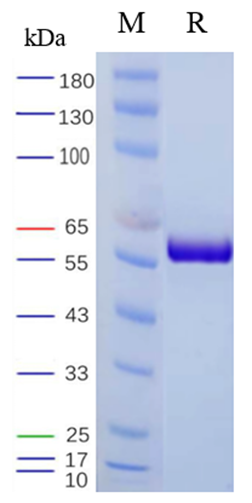
Figure 1.On SDS-PAGE under reducing (R) condition. The gel was stained overnight with Coomassie Blue. The purity of the protein is greater than 95%.
Bioactivity-ELISA

Figure 2.Human ALPP Protein; His Tag was immobilized at 1 μg/ml (100 μL/well). Increasing concentrations of Anti-ALPPL2 mIgG2a antibody were added.
-85 ~ -65℃保存,收到货之日起,6个月有效期。避免反复冻融,建议等分分装为一次实验使用量,分装后,-80℃冻存。
【应用方向】HER2与HER3:ErbB受体家族协同靶向治疗的核心工具蛋白
89
2026-08-31
【应用方向】HER2:抗体药物研发的核心工具蛋白
80
2026-08-31
【应用方向】抗体药研发中常见靶点蛋白及其应用
108
2026-08-31
【应用方向】靶点蛋白在抗体药研发中的应用
88
2026-08-31
【应用方向】GPC3:HCC靶向治疗的核心靶点与药物研发探索
1812
2026-04-24
【应用方向】TROP2:从分子机制到实体瘤靶向治疗的研究进展
1800
2026-04-24
【应用方向】4-1BB-4-1BBL共刺激轴的T细胞活化机制
1087
2026-04-22
【应用方向】TNFR蛋白家族概述
1030
2026-04-21
【应用方向】Klotho蛋白:编织生命之线的抗衰老分子
1179
2026-04-20
【应用方向】药靶明星 | FGFRs家族蛋白解析
888
2026-04-20
【应用方向】解析Fc受体:抗体药物研发的核心靶点与评价基石
909
2026-04-20
【应用方向】FcγR家族:抗体药物研发的基石与核心靶点
948
2026-04-20
【应用方向】CD47-SIRPα轴研究工具与药物开发应用
823
2026-04-20
【技术讲解】ADC药物研究相关靶点汇总
19372
2025-07-30
【应用方向】抗体药筛选的关键—靶点蛋白
11562
2025-07-09


