分子生物学
IVD分子诊断
细胞培养与分析
蛋白研究
细胞因子
重组蛋白
抗体
高通量测序建库
病原检测UCF系列
生物医药
工具酶
抑制剂激活剂与常用试剂
仪器
耗材
Fluo-4, AM, Cell Permeant 细胞膜可渗透钙离子荧光探针
产品详情
FAQ
产品文档
已发表文献
产品介绍

细胞生物学实验中常使用Fluo-4, AM作为一种荧光探针来检测细胞内钙离子浓度变化。其检测原理基于Fluo-4, AM可穿透细胞膜进入细胞,之后被细胞内的酯酶剪切形成Fluo-4,从而被滞留在细胞内。Fluo-4游离配体几乎是非荧光性的,其荧光不会随钙离子浓度升高而增强。但是,当它与细胞内钙离子结合后可以产生较强的荧光,荧光会增加60至80倍。

Fluo-4, AM是钙指示剂Fluo-4, AM的升级版本,主要变化为后者分子上的两个氯原子被Fluo-4, AM上的氟所取代,该结构上的微小变化使Fluo-4, AM加载更快,在相同浓度下检测信号更强。

产品特色
CAS 号(CAS NO.)273221-67-3
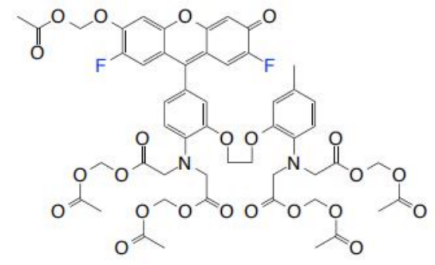
分子式(Molecular Fomular)C51H50F2N2O23
分子量(Molecular Weight)1096.94
Ex/Em(nm, Ca2+-bound)494/516
纯度(Purity)≥90% (HPLC)
外观(Appearance)橙红色粉末
结构式(Structure)


存储条件

室温运输。-20℃避光干燥保存,可保存1年。

FAQ

Q:有哪些比较常见的可见光激发Ca2+荧光探针?

A:Fluo-3 是最常用的可见光激发 Ca2+荧光探针、Fluo-4 是钙指示剂Fluo-3 的升级版本、Rhod-2 是另一种可见光激发的高亲和力Ca2+指示剂。

Q:几种探针的应用的位置?

A:如果是测定胞质内的钙离子建议选择 Fluo-3、4,如果是测定细胞器内较浓钙离子的实验建议采用Rhod-2

Q:通过流式细胞仪可以使用什么指示剂染料来测量钙通量?

A:Indo-1 是流式细胞术的首选染色剂,使用单一激光器进行激发(通常是氩离子激光器的 351-364 nm 谱线)并监测两种发射,Indo-1 的发射最大值从无 Ca2 +培养基中〜475nm  转变为当染料被 Ca2+结合饱和时的〜400nm。Indo-1 比较适用于多色荧光应用。

Q:荧光探针用什么缓冲液稀释?

A:工作液用最好是使用无血清培养基、HBSS 或是 PBS 等缓冲液进行稀释,稀释后的探针工作液即

可直接加入细胞进行检测。

Q:荧光探针装载完多久后观察?

A:为减少各种可能的误差,尽量缩短探针装载后到仪器测定所用的时间(刺激时间除外)。

Q:Fura-2 为什么需要两次不同的激发和发射测定?

A:结合 Ca2+后的最大激发波长从结合前的 380nm 向 340nm(Ca2+饱和时)偏移,其发射荧光强度与结合 Ca2+的浓度存 在定量关系。一般用 340nm 和 380nm 波长激发 Fura-2,在 510nm 处检测发射波长。通过使用与两种激发对应的荧光强度比 率来计算细胞内的钙离子浓度,这种比率测量方法可以消除不同细胞样品间荧光探针装载效率的差异,荧光探针的渗漏,细 胞厚度差异等一些误差因素。

Q:我需要用 Fluo-4 标记细胞进行钙通量分析。标记后多久可以保留染料?

A:将染料加入细胞后,细胞内酯酶从染料中除去'AM'部分。当'AM'基团被移除时,染料能够结合钙和发出荧光。由于染 料不与任何细胞成分共价结合,因此可能会主动从细胞中流出。流出速度取决于细胞的固有特性,培养条件和其他因素。染料可能会保留数小时,数天甚至数周,或在几分钟内丢失。建议染色后应立即进行检测,也可以使用丙磺舒限制主动外流 造成的损失。

Q:加载 Fluo-4 染料检测钙后可以固定细胞吗?

A:不能。因为 Fluo-4 不与任何细胞成分共价结合并且固定会损害膜,染料将不会被细胞保留。

Q:对于人肝星状细胞LX-2建议的Fluo-4工作浓度和孵育时间有吗?

A:参考文献PMID:27473374,可使用0.5uM Fluo-4,AM于37℃孵育15min。

COA
已发表文献
  1. Miao Y, Fu Z, Zhang J, et al. Theoretical quantitative model and clinical outcome predictions of conductive cardiac patches for electrophysiological treatments. Nat Biomed Eng. Published online April 21, 2026. doi:10.1038/s41551-026-01659-x(IF:26.6)
  2. Huang X, Qiu M, Wang T, et al. Carrier-free multifunctional nanomedicine for intraperitoneal disseminated ovarian cancer therapy. J Nanobiotechnology. 2022;20(1):93. Published 2022 Feb 22. doi:10.1186/s12951-022-01300-4(IF:10.435)
  3. Liu C, Li L, Lyu J, et al. Split bullets loaded nanoparticles for amplified immunotherapy. J Control Release. 2022;347:199-210. doi:10.1016/j.jconrel.2022.05.011(IF:9.776)
  4. Wu T, Wang X, Cheng J, et al. Nitrogen-doped graphene quantum dots induce ferroptosis through disrupting calcium homeostasis in microglia. Part Fibre Toxicol. 2022;19(1):22. Published 2022 Mar 24. doi:10.1186/s12989-022-00464-z(IF:9.400)
  5. Peng Q, Guo X, Luo Y, et al. Dynamic Immune Landscape and VZV-Specific T Cell Responses in Patients With Herpes Zoster and Postherpetic Neuralgia. Front Immunol. 2022;13:887892. Published 2022 Jun 1. doi:10.3389/fimmu.2022.887892(IF:8.786)
  6. Zhong G, Long H, Chen F, Yu Y. Oxoglaucine mediates Ca2+ influx and activates autophagy to alleviate osteoarthritis through the TRPV5/calmodulin/CAMK-II pathway. Br J Pharmacol. 2021;178(15):2931-2947. doi:10.1111/bph.15466(IF:8.740)
  7. Dong T, Zhao Y, Jin HF, et al. SNTA1-deficient human cardiomyocytes demonstrate hypertrophic phenotype and calcium handling disorder. Stem Cell Res Ther. 2022;13(1):288. Published 2022 Jun 30. doi:10.1186/s13287-022-02955-4(IF:8.079)
  8. Shen B, Wang S, Bharathi G, et al. Rapid and Targeted Photoactivation of Ca2+ Channels Mediated by Squaraine To Regulate Intracellular and Intercellular Signaling Processes. Anal Chem. 2020;92(12):8497-8505. doi:10.1021/acs.analchem.0c01243(IF:6.785)
  9. Jin T, Lin J, Gong Y, et al. iPLA2β Contributes to ER Stress-Induced Apoptosis during Myocardial Ischemia/Reperfusion Injury. Cells. 2021;10(6):1446. Published 2021 Jun 9. doi:10.3390/cells10061446(IF:6.600)
  10. Li J, Qi F, Su H, et al. GRP75-faciliated Mitochondria-associated ER Membrane (MAM) Integrity controls Cisplatin-resistance in Ovarian Cancer Patients. Int J Biol Sci. 2022;18(7):2914-2931. Published 2022 Apr 11. doi:10.7150/ijbs.71571(IF:6.582)
  11. Liang X, Wu T, Tang M. Microarray analysis of gene expression differences in microglia after exposure to graphene quantum dots. Sci Total Environ. 2020;749:141385. doi:10.1016/j.scitotenv.2020.141385(IF:6.551)
  12. Chang J, Guo Y, Li J, et al. Positive Interaction between H2O2 and Ca2+ Mediates Melatonin-Induced CBF Pathway and Cold Tolerance in Watermelon (Citrullus lanatus L.). Antioxidants (Basel). 2021;10(9):1457. Published 2021 Sep 14. doi:10.3390/antiox10091457(IF:6.313)
  13. Wang X, Yan K, Fu M, et al. EspF of Enterohemorrhagic Escherichia coli Enhances Apoptosis via Endoplasmic Reticulum Stress in Intestinal Epithelial Cells: An Isobaric Tags for Relative and Absolute Quantitation-Based Comparative Proteomic Analysis. Front Microbiol. 2022;13:900919. Published 2022 Jun 30. doi:10.3389/fmicb.2022.900919(IF:6.064)
  14. Peng S, Song C, Li H, et al. Circular RNA SNX29 Sponges miR-744 to Regulate Proliferation and Differentiation of Myoblasts by Activating the Wnt5a/Ca2+ Signaling Pathway. Mol Ther Nucleic Acids. 2019;16:481-493. doi:10.1016/j.omtn.2019.03.009(IF:5.919)
  15. Li N, Liu B, Wu W, et al. Upregulation of transcription factor 4 downregulates NaV1.8 expression in DRG neurons and prevents the development of rat inflammatory and neuropathic hypersensitivity. Exp Neurol. 2020;327:113240. doi:10.1016/j.expneurol.2020.113240(IF:5.330)
  16. Yan Q, Gao H, Yao Q, Ling K, Xiao G. Loss of phosphatidylinositol-4-phosphate 5-kinase type-1 gamma (Pip5k1c) in mesenchymal stem cells leads to osteopenia by impairing bone remodeling. J Biol Chem. 2022;298(3):101639. doi:10.1016/j.jbc.2022.101639(IF:5.157)
  17. Zhang Z, Pan T, Sun Y, et al. Dietary calcium supplementation promotes the accumulation of intramuscular fat. J Anim Sci Biotechnol. 2021;12(1):94. Published 2021 Sep 10. doi:10.1186/s40104-021-00619-6(IF:5.032)
  18. Wu J, Zhang R, Hu G, Zhu HH, Gao WQ, Xue J. Carbon Monoxide Impairs CD11b+Ly-6Chi Monocyte Migration from the Blood to Inflamed Pancreas via Inhibition of the CCL2/CCR2 Axis. J Immunol. 2018;200(6):2104-2114. doi:10.4049/jimmunol.1701169(IF:4.539)
  19. Meng X, Zeng Z, Gao J, et al. Conformational changes in bovine α-lactalbumin and β-lactoglobulin evoked by interaction with C18 unsaturated fatty acids provide insights into increased allergic potential. Food Funct. 2020;11(10):9240-9251. doi:10.1039/d0fo02028a(IF:4.171)
  20. Luo M, Liu Y, Liu N, et al. Proscillaridin A inhibits hepatocellular carcinoma progression through inducing mitochondrial damage and autophagy. Acta Biochim Biophys Sin (Shanghai). 2021;53(1):19-28. doi:10.1093/abbs/gmaa139(IF:3.848)
  21. Wu W, He S, Shen Y, et al. Natural Product Luteolin Rescues THAP-Induced Pancreatic β-Cell Dysfunction through HNF4α Pathway. Am J Chin Med. 2020;48(6):1435-1454. doi:10.1142/S0192415X20500706(IF:3.682)
  22. Li X, Chen M, Yang Z, Wang W, Lin H, Xu S. Selenoprotein S silencing triggers mouse hepatoma cells apoptosis and necrosis involving in intracellular calcium imbalance and ROS-mPTP-ATP. Biochim Biophys Acta Gen Subj. 2018;1862(10):2113-2123. doi:10.1016/j.bbagen.2018.07.005(IF:3.679)
  23. Lv N, Yuan J, Ji A, et al. Perfluorooctanoic acid-induced toxicities in chicken embryo primary cardiomyocytes: Roles of PPAR alpha and Wnt5a/Frizzled2. Toxicol Appl Pharmacol. 2019;381:114716. doi:10.1016/j.taap.2019.114716(IF:3.585)
  24. Xiao J, Feng X, Huang XY, et al. Spautin-1 Ameliorates Acute Pancreatitis via Inhibiting Impaired Autophagy and Alleviating Calcium Overload. Mol Med. 2016;22:643-652. doi:10.2119/molmed.2016.00034(IF:3.530)
  25. Wei T, Liu L, Zhou X. Cortex Dictamni extracts inhibit over-proliferation and migration of rat airway smooth muscle cells via FAK/p38/Bcl-2 signaling pathway. Biomed Pharmacother. 2018;102:1-8. doi:10.1016/j.biopha.2018.03.039(IF:3.457)
  26. Chen Y, Sun T, Niu Y, et al. A partial loss-of-function variant in GNRNR gene in a Chinese cohort with idiopathic hypogonadotropic hypogonadism. Transl Androl Urol. 2021;10(4):1676-1687. doi:10.21037/tau-20-1390(IF:3.150)
  27. Tian C, Li S, He L, et al. Transient receptor potential ankyrin 1 contributes to the lysophosphatidylcholine-induced oxidative stress and cytotoxicity in OLN-93 oligodendrocyte. Cell Stress Chaperones. 2020;25(6):955-968. doi:10.1007/s12192-020-01131-y(IF:2.892)
  28. Tian C, Han X, He L, et al. Transient receptor potential ankyrin 1 contributes to the ATP-elicited oxidative stress and inflammation in THP-1-derived macrophage. Mol Cell Biochem. 2020;473(1-2):179-192. doi:10.1007/s11010-020-03818-3(IF:2.795)
  29. Liang J, Chen F, Gu F, Liu X, Li F, Du D. Expression and functional activity of bitter taste receptors in primary renal tubular epithelial cells and M-1 cells. Mol Cell Biochem. 2017;428(1-2):193-202. doi:10.1007/s11010-016-2929-1(IF:2.669)
  30. Xu W, Lu C, Zhang F, Shao J, Zheng S. Dihydroartemisinin restricts hepatic stellate cell contraction via an FXR-S1PR2-dependent mechanism. IUBMB Life. 2016;68(5):376-387. doi:10.1002/iub.1492(IF:2.653)
  31. Zhu D, Chen C, Xia Y, Kong LY, Luo J. A Purified Resin Glycoside Fraction from Pharbitidis Semen Induces Paraptosis by Activating Chloride Intracellular Channel-1 in Human Colon Cancer Cells. Integr Cancer Ther. 2019;18:1534735418822120. doi:10.1177/1534735418822120(IF:2.634)
  32. Yue X, Liang J, Gu F, Du D, Chen F. Berberine activates bitter taste responses of enteroendocrine STC-1 cells. Mol Cell Biochem. 2018;447(1-2):21-32. doi:10.1007/s11010-018-3290-3(IF:2.561)
  33. Jin X, Xu Z, Fan R, et al. HO‑1 alleviates cholesterol‑induced oxidative stress through activation of Nrf2/ERK and inhibition of PI3K/AKT pathways in endothelial cells. Mol Med Rep. 2017;16(3):3519-3527. doi:10.3892/mmr.2017.6962(IF:1.692)
联系我们
购物车
客服
转染试用