

 推荐应用
推荐应用
Hydrolase that can specifically remove 'Lys-48'-linked conjugated ubiquitin from proteins and plays an important regulatory role at the level of protein turnover by preventing degradation. Regulator of T-cell anergy, a phenomenon that occurs when T-cells are rendered unresponsive to antigen rechallenge and no longer respond to their cognate antigen. Acts via its interaction with RNF128/GRAIL, a crucial inductor of CD4 T-cell anergy. Isoform 1 destabilizes RNF128, leading to prevent anergy. In contrast, isoform 2 stabilizes RNF128 and promotes anergy. Surprisingly, it regulates RNF128-mediated ubiquitination, but does not deubiquitinate polyubiquitinated RNF128. Deubiquitinates estrogen receptor alpha (ESR1). Mediates deubiquitination of 'Lys-48'-linked polyubiquitin chains, but not 'Lys-63'-linked polyubiquitin chains. Not able to cleave di-ubiquitin. Also capable of removing NEDD8 from NEDD8 conjugates, but with a much lower preference compared to 'Lys-48'-linked ubiquitin.Plays a key non-catalytic role in DNA repair regulation by inhibiting activity of RNF168, an E3 ubiquitin-protein ligase that promotes accumulation of 'Lys-63'-linked histone H2A and H2AX at DNA damage sites. Inhibits RNF168 independently of ubiquitin thioesterase activity by binding and inhibiting UBE2N/UBC13, the E2 partner of RNF168, thereby limiting spreading of 'Lys-63'-linked histone H2A and H2AX marks. Inhibition occurs by binding to free ubiquitin: free ubiquitin acts as an allosteric regulator that increases affinity for UBE2N/UBC13 and disrupts interaction with UBE2V1. The OTUB1-UBE2N/UBC13-free ubiquitin complex adopts a configuration that mimics a cleaved 'Lys48'-linked di-ubiquitin chain.MiscellaneousIn the structure described by PubMed:18954305, the His-265 active site of the catalytic triad is located too far to interact directly with the active site Cys-91. A possible explanation is that OTUB1 is in inactive conformation in absence of ubiquitin and a conformation change may move His-265 in the proximity of Cys-91 in presence of ubiquitin substrate.
稀释比 WB:1/500-1/1000; IP:1/20
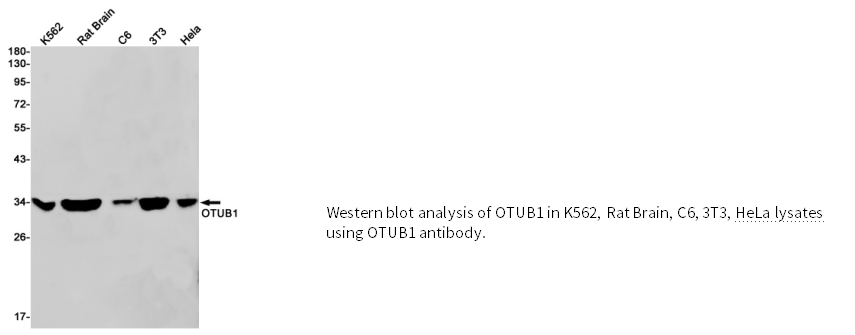
Western blot
-25 ~ -15℃保存,收到货之后有效期1年,避免反复冻融。
【应用方向】单细胞表观测序中的抗体应用
39
2026-07-29
【选购指南】类器官研究之构建与起始细胞鉴定抗体推荐
321
2026-07-21
【选购指南】类器官研究之功能成熟度评估抗体推荐
284
2026-07-21
【应用方向】趋化因子信号传导通路——身体“信号导航”解析
295
2026-07-21
【选购指南】重度抑郁症(MDD)通路研究抗体推荐
254
2026-07-21
【选购指南】帕金森病(PD)代谢机制核心抗体研究指南
291
2026-07-21
【应用方向】抗体助力心脏免疫研究——解锁心衰防治新方向
242
2026-07-21
【应用方向】抗体助力心肌肥大与心衰研究:从基础探索到科研应用
285
2026-07-21
【应用方向】抗体助力癌症代谢通路研究——肿瘤代谢科普与研究工具指南
290
2026-07-21
【应用方向】心肌再生研究与抗体应用解决方案——助力心血管修复机制解析
13742
2026-03-18
【应用方向】抗体应用研究——心肌纤维化解析
20390
2026-04-14
【技术讲解】抗体赋能心肌梗死研究—精准靶向,助力科研突破
7343
2026-04-14
【应用方向】抗体应用研究—心肌发育的分子解析与前沿转化
15040
2026-04-14
【应用方向】抗体应用研究—细胞死亡
20273
2026-07-16
【应用方向】经典信号通路-JAK/STAT信号转导通路及抗体推荐
13186
2026-04-14


